 Referral
 Points of sale
Main nipple piercing techniques
Two main approaches exist:
1. With clamp
The clamp holds the nipple and provides a fixed reference point.
If properly positioned on the marking points, you simply work perpendicularly, especially with a catheter.
Drawback: the clamp can be painful as it applies strong pressure on a very sensitive area.
2. Freehand
The gesture is performed without a clamp, directly with the needle (blade or catheter).
This requires more precision and experience, but reduces the pain caused by clamping.
Adaptation to morphology is paramount: angle, depth and symmetry must be perfect.
In both cases, precision is key. Good positioning avoids asymmetries and ensures a lasting, aesthetic piercing.

Refer and save
Get 15% off for each successful referral.
Your referrals get 10% off their first order.
 Get my referral code
Anatomy and optimal positioning
Every nipple is different: some are flat, others protruding or slightly inverted. The piercer must adapt the piercing axis to:
capture maximum tissue,
ensure good jewelry hold,
guarantee symmetry between both nipples (for bilateral piercing).
You cannot have one nipple pierced at 90 degrees and the other at 45 degrees. Consistency and symmetry are essential.
Diameter choice: why 1.6 mm is essential
This is a golden rule too often overlooked:
A nipple piercing must be performed with a minimum 1.6 mm diameter.
For larger nipples, it is even possible to work in 2 mm, provided you have the right jewelry.
Why is this choice crucial?
The thinner the jewelry, the more it cuts into the skin. It is the same principle as a wire cheese cutter: the thinner it is, the more it slices.
Jewelry that is too thin (e.g. 1.2 mm) increases the risk of nipple tearing or long-term weakening.
The nipple being a highly stressed area (friction, contact, clothing pressure), it must be pierced with a diameter that guarantees strength and safety.
Summary: never 1.2 mm, always 1.6 mm minimum, or even 2 mm for anatomies that require it.
Piercing and legal age: an ethical imperative
Nipple piercing is strictly prohibited on minors, even with parental authorization.
This is an intimate area: performing it on a minor raises serious ethical questions.
In France, the law prohibits this type of piercing before the age of majority.
Choosing the right jewelry: hypoallergenic titanium
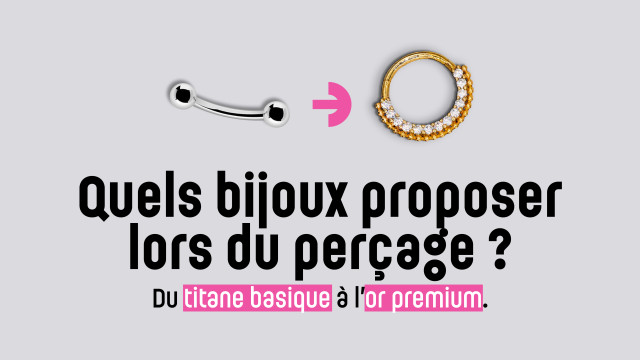
The initial jewelry must always be implant-grade titanium (or, in certain cases, 18-carat gold).
Avoid surgical steel or cheap alloys that increase the risk of allergy and delay healing.
Premium jewelry promotes healing and considerably reduces complications.
Also read: How to choose the right piercing jewelry?
Helping the nipple protrude before piercing
For certain anatomies, especially flat or inverted nipples, several techniques exist:
Applying cold physiological saline on a pad to stimulate the nipple.
Gentle stimulation with a cotton swab.
Occasional use of breastfeeding patches, which help bring out an inverted nipple before the session.
These methods must always be performed in a strict hygiene setting and with the client's consent.
Ergo kits: a complete solution for nipple piercing
For piercers seeking safety, comfort and practicality, Ergo Piercing kits offer a real advantage:
Simplified traceability: each kit has a unique label, making it easy to trace the material used, a real plus for insurance and client follow-up.
An ergonomic clamp: designed to fit the nipple, allowing precise and comfortable work whether piercing with a catheter or blade.
Freehand kits for the advanced: the Ergo range also offers kits suited to freehand technique, for piercers who wish to work without a clamp.
A sterile drape adapted to the zone: more practical than many competing kits, the Ergo drape is designed to effectively cover the chest area and allow a fluid gesture.
All-in-one: antisepsis, marking, needle, drape and accessories — everything is ready, saving time and reducing preparation errors.
With Ergo kits, the piercer has a ready-to-use tray, designed to adapt to all techniques and guarantee an optimal experience for both client and professional.
Simplify the way you work:
with all-in-one equipment, ready to use, sterile and single-use.
 Order Ergo kits
Training and learning nipple piercing
Mastering this piercing requires proper training. Several seminars allow you to learn or refine the technique:
MU in Dijon: small group format with piercing zone.
FRAP in Bordeaux: recognized seminar with practical workshops.
Belgian PPS: more underground atmosphere, but also with a practical piercing zone.
These training sessions allow you to observe, practice in real conditions and develop essential precision.
Also read: Training and opening up: the importance of seminars
Insurance and professional liability
Contrary to what one might think, insurance does not directly cover aesthetic mishaps (a slight offset for example).
However, failure to comply with hygiene rules can have legal and health consequences.
Material traceability and compliance with asepsis protocols remain your best protections.
Conclusion
Nipple piercing is not a trivial procedure: it combines technique, anatomical precision and ethical responsibility.
Clamp or freehand, each method has its advantages, but precision remains the key word.
Diameter choice is essential: always 1.6 mm minimum, never thinner, to prevent tearing and ensure strength.
Hypoallergenic titanium jewelry ensures better healing.
Ergo kits offer a practical and secure solution, with exemplary traceability and tools adapted to all techniques.
Finally, continuing education and compliance with hygiene rules allow the piercer to offer the client a safe and aesthetic experience.