 Referral
 Points of sale
In piercing, everything begins before the needle.
The skin is a barrier. It protects. It filters. And it does not forgive improvisation.
Yet too many piercers still use incomplete asepsis protocols, sometimes just out of habit, sometimes out of ignorance.
At Ergo Piercing, we explain what the French regulations say, what they expect from you... and how to do it simply, without any hassle.
The official protocol in France (and Europe)
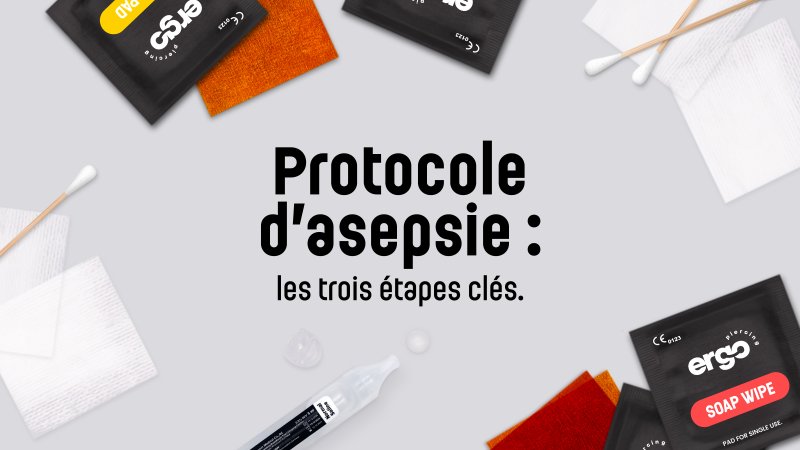
In France, asepsis before skin piercing follows three key steps:
1. Skin cleansing (detersing)
Before any antisepsis, the skin must be clean:
Moisten the area with physiological saline (or sterile water).
Apply a mild soap, or ideally a soap containing the same active molecule as the upcoming antiseptic:
If povidone-iodine-based antiseptic, use povidone soap.
If chlorhexidine-based antiseptic, use neutral soap.
This step removes sebum and impurities, and allows the antiseptic to work properly.
2. Wiping (clean but not sterile)
Then wipe the skin with a clean, lint-free pad.
It does not need to be sterile at this stage.
No cotton or paper towels.
A simple pad is enough, as long as it is clean and used correctly.
3. Antisepsis (double disinfection)
This step is mandatory in France:
Apply an antiseptic twice:
Either povidone-iodine,
Or alcoholic chlorhexidine.
A single combined alcohol + povidone wipe is not compliant.
Two distinct steps, two passes are required.
Sterility: not during prep, but mandatory for the procedure
Skin preparation (cleansing + antisepsis) does not require sterile equipment:
No need for sterile gloves
No need for a drape or sterile zone at this stage
But be aware: the piercing itself must be 100% sterile.
At that point:
You set up your sterile tray
You put on your sterile gloves
You only use sterile single-use material (or autoclave-sterilized)
And then, you no longer touch the skin without a sterile barrier.
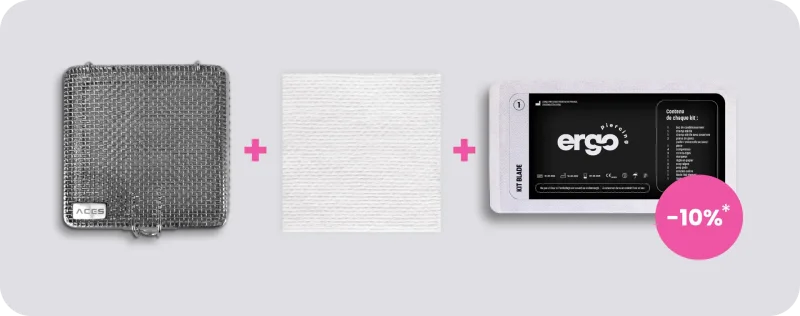
On this topic, discover our great collab with Aces: the Pro Pack Aces x Ergo.
With this unique pack, Ergo Piercing partners with ACES to combine three daily essentials in a single offer: the famous Ergo Box filled with your favorite piercing kits, the SteriSonic box, a jewel of stainless steel engineering, and the box of 100 SteriSonic Pads (non-woven, non-sterile pads specially designed with a unique weight).
The ultimate Pro Pack
ACES x Ergo Piercing -10% on your Ergo box Order my Pro Pack
What a pro no longer does
Here are the mistakes still seen too often:
Not washing the skin before the antiseptic
Using only one mixed alcohol + povidone pad
Not following the two disinfection steps
Piercing without a sterile tray or gloves
Working with cotton, paper towels, or a non-waterproof woven drape
Ergo Piercing: kits that put you right on track
Ergo Piercing was designed by piercers, for piercers:
Individual pads ready to use, soaked in stable povidone (5-year shelf life)
Kits with waterproof ear drape, pad, saline, needle and components ready to pierce
A simple approach, compliant with French standards, usable with or without an autoclave
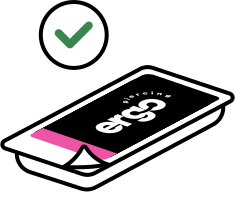
Simplify the way you work:
with all-in-one equipment, ready to use, sterile and single-use.
In summary
The asepsis protocol is not "steps to follow if you have time".
It is the foundation.
It is what differentiates a professional from an amateur.
And it is what prevents a piercing from turning into a nightmare.
At Ergo Piercing, we give you all the tools to stay straight, clean and compliant.
The rest is where your talent speaks.

Refer and save
Get 15% off for each successful referral.
Your referrals get 10% off their first order.
 Get my referral code