 Referral
 Points of sale
Asepsis and antisepsis: the essential preparation
Before any piercing, preparing the area is the key to successful healing:
- Initial cleansing: moisten the inside and outside of the nostril with a sterile pad soaked in physiological saline.
- Mild soap / neutral pH: clean quickly, rinse immediately. A second pass is possible with a new pad if necessary. The soap is not the antiseptic: rinse it off, do not leave it on.
- Drying: dry the area carefully (sterile pad). Moist skin reduces the effectiveness of the antiseptic.
- Antiseptic (single agent): apply either aqueous chlorhexidine or dermal povidone-iodine. Never both together. Never use alcohol on the nose.
- Contact time: let the antiseptic act for 2 to 3 minutes. During this time, explain aftercare to the client, validate placement or prepare the drape.
It is the antiseptic (not the soap) that needs contact time to guarantee its effectiveness.
Also read: The asepsis protocol for piercing
Marking: precision and communication
It is advisable to perform marking before the antiseptic, with gentian violet:
The dot remains stable,
You apply antiseptic around it to avoid erasing it.
Alternative: mark after antisepsis with a sterile marker, once the skin is dry.
Ergo recommends marking before: the client validates the placement, settles in, and no longer touches the area.
Recommended height: 8 mm, as rings are generally available in even sizes (6 mm too small, 10 mm too large). With 8 mm, you ensure a result suited to the majority of anatomies.

Refer and save
Get 15% off for each successful referral.
Your referrals get 10% off their first order.
 Get my referral code
Diameters and needles
Recommended standard: 0.8 mm: discreet scar, thin initial jewelry, ideal for a young or hesitant clientele.
Alternative 1.2 mm: offers more jewelry choices and reduces loss thanks to screw or clip systems. But the scar will be more visible.
Also read: Piercing needle guide: choosing the right size for each area
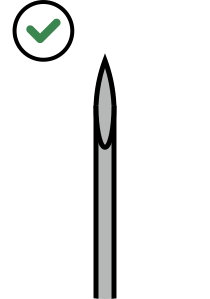
Kiwami Needles©, Japanese precision.
The sharpest blade on the market, finally sold sterile and ready to use — only at Ergo Piercing.
 Order a blade kit
Catheter vs Needle (Ergo recommendations)
Needle: pierce in 16G with Kit F1 (freehand).
Catheter: pierce in 20G with Kit B (nose), or Kit A depending on the area/anatomy.
Needle and catheter gauges are not equivalent: always anticipate a slight offset.
Also read: Catheter or blade (needle): which needle for a successful piercing?
Fitting methods
With clamp: traditional method, easy framing.
Freehand (without clamp): more technical method, gaining popularity, but requires rigor and experience.
In all cases, respecting the sterile field and the sequence asepsis, marking, fitting remains the absolute priority.
Jewelry and supplier choice
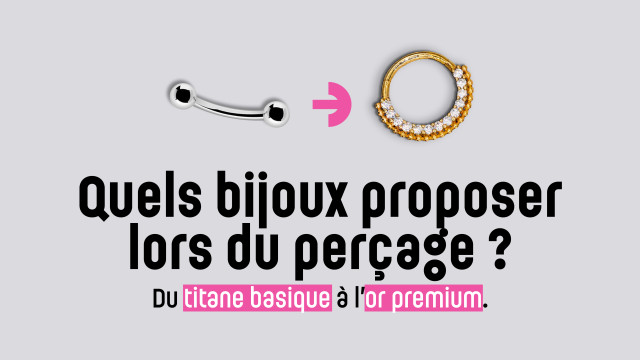
Recommended initial jewelry
0.8 mm studs: the safest choice for initial fitting: comfort, simpler healing, fine scar.
Never a ring for initial fitting: movements and friction delay healing and increase complications.
Tolerable alternative: for studios that still want to offer something that "looks like" a ring, the least bad option remains the D-shaped half-ring.
Its shape reduces tension, limits losses compared to classic studs,
But it is more prone to friction and less stable than a stud: reserve for specific cases.
Also read: How to choose the right piercing jewelry?
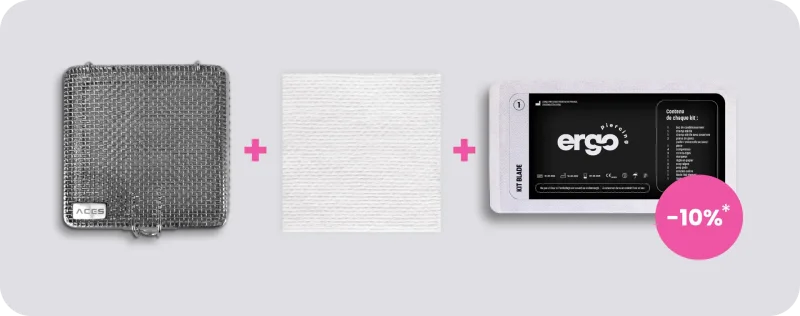
The ultimate Pro Pack
ACES x Ergo Piercing -10% on your Ergo boxSuppliers in France
Antikorps: renowned for their 0.8 mm labrets, reliable internal threading.
Ptit Rock: specialist in "classic" nose studs, wide choice, competitive prices.
These two suppliers are the most competitive and established on the French market in 2025.
Why an Ergo Piercing Kit?
Ergo Piercing kits bring together everything you need in a single sterile box ready to use:
pads, drape, gloves, marker, millimeter ruler,
pink catheter 20G or 16G needle depending on the method,
simplified asepsis protocol,
a single traceability label,
a compact, eco-friendly and practical format.
With Ergo, you save time, reduce handling and guarantee a standard compliant with 2025 norms.
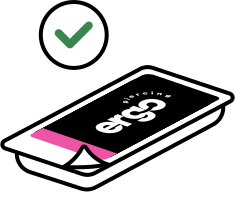
Simplify the way you work:
with all-in-one equipment, ready to use, sterile and single-use.
Conclusion
Nose piercing remains a highly requested procedure, but it requires a precise and rigorous protocol. Asepsis, antisepsis, marking, needle choice and jewelry: every step counts.
In 2025, using a professional sterile nose piercing kit has become an essential standard.
With Ergo Piercing, studios have kits designed for simplicity, compliance and performance.